
Risers, roofs and reserved rights: The legal reality of high-rise data centres
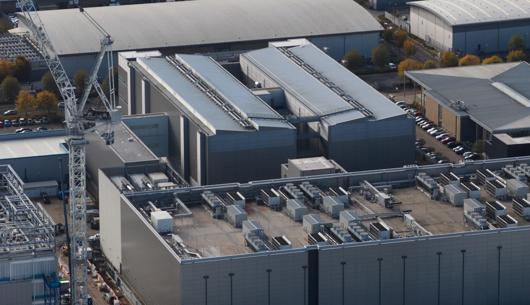
Most people have heard data centres categorised as ‘big sheds’. But, that description starts to fall flat once the building has lifts. London has been living with multi-storey data centres for years. Telehouse’s 11 storey North Two centre launched its first phase in 2016. More recently, Telehouse has broken ground on its West Two centre (a nine-storey development), Vantage’s Park Royal scheme has been delivered as a six-storey facility, and Colt’s London 4 plans at Hayes are clearly multi-storey too.
Why data centres are going vertical
So, why go vertical? Some types of data centre work can move out to cheaper land, closer to larger power sources, with relatively little impact on the end user. On the flipside, other demand is less mobile. It’s tied to dense networks and to customers that care about response times, not just total capacity. That’s one reason the UK data centre market has historically clustered in a small number of regions (predominantly the Greater London area, with Manchester as a secondary cluster). London’s concentration has been driven, in part, by low latency transactions at scale in banking and finance.
Where real estate law meets real operational risk
None of this is conceptually new to real estate. Tall residential and office buildings with mechanical and electrical plants, risers, roof rights, servicing routes and more complicated management arrangements are very common. For a vertical data centre, those familiar issues have unusually direct operational consequences.
For vertical centre contracts, a few distinct pressure-points appear:
Power, fibre and cooling have to travel up the building
The documents need to say, clearly, what routes are granted, which parts are exclusive, what access is permitted, and how future upgrades are handled without turning every change into a dispute. A right to use a riser is not the same thing as a right to increase capacity.
The roof is working space
On paper it is easy to grant 'rights to use the roof'. In practice, rooftop plants need replacement, screening changes, and occasional heavy lifts. Landlord reservations also need to be carefully considered. A retained right that would be harmless on an office block can be an operational constraint on a live data centre.
Demise and control need an operating model
We’re also starting to see data centres appear as components within wider mixed-use schemes, which makes the common parts and shared-systems drafting more than just standard lease mechanics. If the landlord retains cores, lifts, yards, compounds or plant rooms, the lease has to describe how day to day control works: security, deliveries, testing regimes, emergency access, and the inevitable ‘out of hours’ events. In a 24/7, time critical environment, small delays become big problems.
Alterations and reinstatement clauses need to be fit for purpose
For a tall data centre, ‘alterations’ often mean major engineering work. Clauses borrowed from standard office forms won’t be entirely suitable.
These buildings aren’t novel in engineering terms. The real estate sector has worked with tall, service intensive buildings for decades. What’s different is how little tolerance a live data centre has for ambiguity.
Clear rights, fewer arguments: The goal of vertical data centre leasing
The real question isn’t whether the building works on day one. It’s whether it still works after the third plant replacement, the first capacity increase and the first operational incident that happens at 2am.
At the end of the day the aim is to make the asset boring to run and boring to trade. Clear vertical rights, clear retained parts, a workable access and replacement regime, and an alterations framework that anticipates upgrades rather than panics about them. If you get that right, the exit, the next expansion, or the refinance will merely be a document exercise rather than a full-fledged argument about what everyone thought they were getting.
To find out how our real estate team can help you navigate the legal complexities of data centre developments, please get in touch.

Discover more
Related expertise
You may be interested in
Risers, roofs and reserved rights: The legal reality of high-rise data centres
Google-Constellation nuclear uprate deal: What this means for the UK’s data centre power strategy

Browne Jacobson advises WhiteSpider on deal to strengthen digital resilience across UK critical national infrastructure

The UK Cyber Security and Resilience Bill: What you need to know

Widescale clean energy is within reach – but the legal groundwork needs to happen now
Ofgem's proposed data centre connection reforms: A significant cost to play and stay

Data centres in a heatwave: An industry confronting its own contradiction
Heat as the ‘second connection’: Why UK data centres need a heat strategy

Browne Jacobson and CBI to launch report on future of PPPs in financing infrastructure at UKREiiF
Data centres and on-site energy generation
Data centres and business rates: A tax on megawatts?

Data centres and quantum AI: Location, location, millikelvin

Construction

Navigating UK and Ireland data centre development in 2026: Guidance for investors and operators
Beyond the uptime guarantee: Key points for UK data centre SLAs

The impact of agentic AI on English contract law
Data centres: Legal challenges and trends in 2026

AI and emerging legal challenges in construction

CRU issues decision on private wire connections for Irish data centres

Securing data centre power: Strategic steps to navigate the UK's new grid connection regime

UK data centre expansion creates insurance challenges

Cookie compliance crackdown: SHEIN fined €150 million by CNIL

English Devolution Bill: Is it the end of upwards-only rent reviews?

“Silent AI”: The risk of unintended consequences

Inward investment in the UK and Ireland in 2025: Sector focus

Spending Review: Setting the stage for UK investment

Outsourcing contracts in the age of AI
Data centres in Ireland: The Commission for Regulation of Utilities (CRU) Proposed Decision

Browne Jacobson advises the shareholders of Termate Limited on sale to N Industries Group Limited