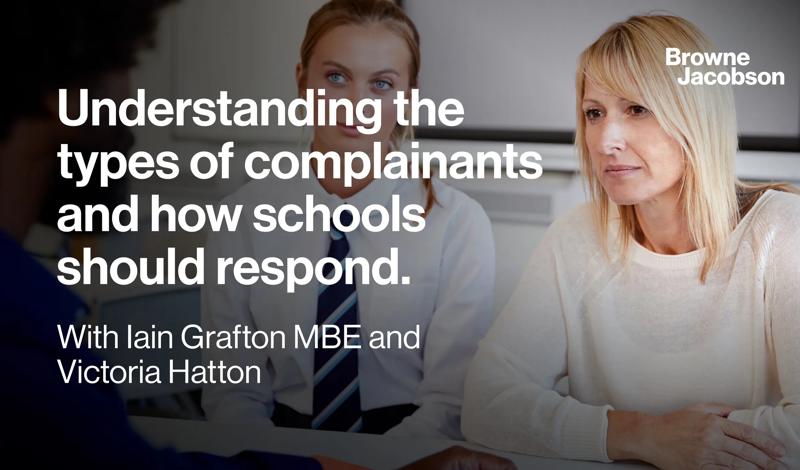
I'm Vicky Hatton, Partner at Education law firm, Browne Jacobson. I'm delighted to be joined today by Iain Grafton MBE, whose unique career trajectory from detective to superintendent to school governance specialist gives him a unique insight into one of education's most challenging issues: managing parent complaints.
With 30 years' service in the police, and over 20 years' experience in school governorships, including in primary and secondary schools, Iain has a clear framework for helping schools to identify the types of complainants and how to respond appropriately.
Before we start to have a look at the different types of complainants, where did the framework for the six different types of complainant come from?
So the framework comes originally from a piece of academic work conducted by the University of Victoria in Australia, probably about 30 years ago now. They were leading the world in trying to better understand why some really serious atrocities committed by people against often multiple victims of homicide took place. What was it about the person that ended up being responsible for those acts that took them from where they started as potentially ordinary, reasonable, normal people, and drove them into a position where they found that the only way they felt they could be heard was to carry out something atrocious in the community.
And as a result of that academic work being shared with law enforcement agencies around the world, the piece of work in question made its way to the United Kingdom in the early 2000s and became the basis for a nationwide rethink by the police forces in England and Wales of the way in which they handle, understand, and support people who make complaints about the police — in order to ensure that the police didn't overlook somebody who may be suffering from a state of mind that could take them from being an ordinary, reasonable person into a state where they could commit something atrocious, as had been the case around the world.
In fact, it suddenly all made sense to me because the university identified six different types of profile of personality that would really help to explain why people feel so aggrieved at some point that they will do something atrocious. Post that professional role and that understanding of the way people complain about the police service, it seemed to me perfectly logical to transfer that learning and share it within the world of education. And so it has made its way quite neatly into the world of governance and has been something that I feel we've done well to share with others to help them understand how to be better at responding to public complaints — but also, if necessary, even to workplace grievances as well as other matters of misconduct or gross misconduct that might from time to time involve school governors or trustees if they're working in the multi-academy trusts.
We've spoken before on a number of occasions about the different types of complainant. How does understanding about the types of complainant help schools in managing parental complaints today, do you think?
I think what it does is it helps you to set yourself up to have the most probable chance of reaching a speedy resolution with the person who's raised the complaint. Let's talk about a public complaint in this case, rather than a workplace grievance. It gives you the best opportunity — you're not always going to be successful because we are dealing with people — but it gives you the best opportunity to get a successful resolution effectively, with the minimum amount of management time being invested in that to get an effective outcome.
And what it does is it says to you, as a person whose responsibility it is to try and resolve this complaint, be aware that the person you are dealing with who has raised a complaint will probably fit into one of six different categories. And until you understand which of the six categories that person is in, when they have that first interaction with you, you won't have a great chance of resolving the complaint — because for each of the six different types, there are six different approaches to managing that person and their complaint. And the six responses don't mix well with the six types. So the key to this is, firstly, understand why it is someone's complaining and what their complaint is about and where they are on their journey with that complaint. And then select the best approach to dealing with them, focusing all the time on trying to get a pragmatic, settled resolution and an outcome within the policy that you have for dealing with complaints.
So Iain, can you talk us through the six types of complainant?
So Type 1 we would refer to as normal, reasonable, ordinary people — the vast majority. Type 2 are difficult or awkward people. Type 3 are those who are either acting through a degree of dishonesty or they're motivated by compensation — litigious people. Type 4 are altruistic complainants who are genuine people, but just act on behalf of others and feel they need to do that. Type 5 are people who make complaints for hobbies, because they do exist. And then Type 6 are the tiniest proportion of all the complainants but they present the biggest challenge to organisations, because they are the querulous, the vexatious, the unreasonably difficult, the rude, the irrational, the intolerant. I could go on. People will have an understanding of that sort of category, I'm sure — what we're trying to describe as Type 6, the most difficult and the most challenging.
Before we go on to talk about the different types of complainant and how best to respond to each type, can complainants transform from one type to another type? And what are the triggers for that?
So you are into some of the finer detail of the work that was covered by the university, and the answer to that simply is yes, they can — and there are two main reasons why people can transform from one type to the other. The principal reason is they will transform as a result of the way that they are treated by the organisation that they are complaining about. So it's key to understand that our response to their complaint has a significant impact on the way in which they will behave towards us, and of course whether the chances of us ever getting a successful resolution will be reached.
The second reason that people transform from one to the other is because they're people. Nobody exists in a silo of category one to six. There are some features that occur more than once in the different typologies, but they're not the main features, and we have to remember that as people, we're dealing with people that are all different and it's not a precise science to place somebody in a Type 1 category and say they'll only ever present as Type 1, or similarly for Type 5 as an example.
And tell us about Type 1 — the reasonable or normal complainant — what characterises that type of complainant and how should schools respond?
So Type 1 complaints — and I'm going to say this now — we're all Type 1 complainants when we first make a complaint; we're all normal, ordinary, reasonable people. And I say that with a wry smile because actually when you dig into it, we all want the same outcome that Type 1 complainants want: we want a quick, proportionate, appropriate resolution, which might be no more than an apology, or might be a change of something that means it won't happen to somebody else.
And the sort of language you'll hear from Type 1 people is: "I don't wish to make a big fuss. I'd rather this doesn't happen to anybody else." "I'm not looking to build an enormous process out of this — can we just have a meeting so that I can understand why this went wrong?"
This is about service recovery at the earliest point that you can in the process. And it is saying to people in schools — and I've been challenged on this by school leaders — when I say to them if you get a complaint about your school in the morning, whatever you've got in your diary for the rest of the day doesn't matter, because that complaint has to take priority. Now, I understand if you're dealing with something for safeguarding or you've got some serious welfare issue around staff or a child, you're going to prioritise that. The reason I say it should be the number one item in your in-tray or in your inbox is because the longer that we wait to deal with a complaint for an ordinary, reasonable, normal person in Type 1, the less the chances are that you'll get a successful resolution — because you are already moving them towards Type 2.
And tell us about Type 2 then — the difficult complainant. You've explained that our behaviour towards the complainant can move somebody from a Type 1 normal complainant to a Type 2 difficult complainant. What characterises the Type 2, and again, how should schools respond?
So Type 2 will be clearly identifiable from Type 1 because they won't be very happy. It'll be the same complaint, but there is a potential it might be exaggerated. There's a potential it might have happened once in the first instance to the complainant, but by the time they're in Type 2, they may say, for example, it's happened two or three times. That's not to confuse them with someone who's dishonest in Type 3. This is because the person in Type 2 now believes they're not getting an audience — they're turning up the volume of the complaint. So the complaint is the same, but they might exaggerate details and they might talk to you about it in a more aggressive and unhelpful way, because they feel they've been let down when they were in a Type 1 state.
Hence the reason why it's so important to get hold of that complaint when it's at Type 1 state and deal with it, because the passage of time will push somebody potentially into Type 2. And the outcome that they want originally — which might have been an apology — now they want something more formal. Whereas you might have dealt with that quickly within 24 hours, now you're probably going to have to put an investigation together and maybe a governor is going to have to look into it. We've created work for ourselves because we didn't deal expeditiously with that complaint when that person was in Type 1 state.
And how should schools respond to Type 1 and Type 2 complainants differently? What characterises the response?
I think it's the formality — the degree of formality. And regrettably, if someone has gone to Type 2, they probably have now looked at the complaints policy. They probably now will have an expectation of what is going to happen with the way in which the school's policy is written, and there is an issue there within those policies — those policies don't necessarily deliver any better outcome at the end of a process than you could have delivered pretty quickly at stage one. So the key to stopping this getting to stage two is to deal really quickly with somebody who is at stage one. Because, in essence, somebody who's stage two can be dealt with and this will be resolved — it just takes more work and more time to do it.
Type 3 complainants are the litigious complainants, or dishonest complainants. What characterises those complainants, and again, how do schools respond to those appropriately?
So let's start with the litigious. The litigious are very straightforward to identify because very early on in the conversation — and these will present as normal, reasonable people, by the way, they won't be angry. They won't necessarily be difficult or awkward. They will be perfectly reasonable and you might think at first instance this is a Type 1 complainant. The point at which it changes to Type 3 is the point at which they say to you that the only way this is going to be resolved is through some sort of financial compensation. Some sort of financial settlement will make this go away.
And the advice that we give within governance around that, in school governance, is that those complainants — we wouldn't expect a school governor or a school leader to deal with somebody who seeks financial compensation as an outcome. In the local authority schools, the advice is to refer that to the local authority's legal team and not to get involved in negotiating a financial settlement. And if it's in a multi-academy trust setting, our advice is to go to your legal providers and ask them to assist in trying to resolve that particular problem. So in some ways, if you find yourself dealing with a Type 3 complainant who wants a financial settlement from the get-go, you're not going to be doing much work yourself — it's time to get in some help.
If they're dishonest, they won't necessarily talk about the money. They'll be talking more about greater exaggeration than perhaps you saw in Type 2. Hence the reason why we have to be clear about the differentiations in the types, because Type 3 people can be dishonest and can exaggerate, but they won't necessarily be unreasonable and angry. But the reason that they're complaining is the focus — if you feel that someone is dishonest about what they're complaining about, you need to challenge them about that. If you believe that it can't be true, that the nature of the complaint simply couldn't be the case, they must be challenged.
Often that complaint is motivated from a point of view of theirs where they want to deflect — they want to take away attention from another problem that might get them into some difficulty and send you down a rabbit hole, for want of a better word.
An example of a Type 3 dishonest complainant, then — based on your example — could be somebody who perhaps is going through family law proceedings and is perhaps having difficulty with that.
I think you're right, Victoria. I think the key thing to remember with dishonest people is often there is another process or processes running for them in their lives, which is a challenge for them. So if we look at it in terms of law enforcement and the criminal justice arena, often what we would see with a dishonest complainant is the complaint raised by the person who is now under investigation by the police, and possibly has been charged, who now wishes to somehow deflect their liability and bring a complaint about the way in which the officer who dealt with them behaved towards them.
And your other point about the family law — we know, sadly, that a lot of cases involving families that also affect children who are in school are much the same. It may not necessarily be about the law enforcement element of the court, but it would be about perhaps children's services or another service that's working with the family that overlaps into the school, into the school day. And they can be quite tricky complaints to deal with, because if you start bringing in other agencies and other processes that child or that family are involved in a Type 3 dishonest complaint, which you don't necessarily believe and has been brought in to try and deflect, still generates a lot of work, potentially for no outcome. And an interesting feature of people who go into Type 3 is that they can be quite strident and quite persistent in their behaviour, and then suddenly they'll tell you the complaint's been withdrawn.
And that's because it no longer serves their purpose and they disappear as quickly as they first emerged. And that's the key sign that tells you there's something else going on behind the scenes. I don't think we'll have that many of them, but they're worth knowing about.
Type 4 complainants — the altruistic complainants. How do they emerge in the school context?
So typically, a Type 4 altruistic complainant is someone who is, to start from the beginning, a normal, reasonable, ordinary person who's more than capable of articulating a complaint, if it was theirs. However, they're distinctly different in Type 4 because the complaint isn't theirs, or potentially it might be theirs in partnership with a lot of other people. So they put themselves forward as the spokesperson. They are the people who take on the cause, if you will, of a group of others.
And that's not unusual in a school context because there are parents and carers who do find it quite challenging to engage with school leaders. They maybe didn't have a great time at school themselves when their experience of schooling wasn't positive. For them to come into school is always potentially a challenge, and then to bring into the school environment a complaint, or some expression of dissatisfaction, they tend to then keep quiet.
And that's not great, because we need to understand what's not going well if the service that we're providing isn't going well.
So to have a spokesperson step forward, to have the person who takes on the cause, is not unusual, and they are reasonable people to deal with. The challenge for us in schools and colleges with people who put themselves forward as the spokesperson is that we cannot communicate with them back to the group because of the issues around data protection and the sensitivities of other children's situations that might become apparent through the investigation. So there's always a reason to do an investigation if that's what's required for someone who raises a Type 4.
But we have to be really clear on how we communicate, what are the channels of communication that are going to go back to the group of — however many parents might be being represented. The positive message with Type 4 complainants, if they are doing that on behalf of others, is you can work with them really positively and your chances of an outcome are really high. It's just that communication difficulty — we have to make clear from the outset that you can't share with that person things that relate to third party families and children.
Type 5: The Hobby Complainant
I'm sure people have heard of these ones before and experienced them, potentially. Again, in the school context, how does that emerge? What are their characteristics and how should schools respond?
In the first instance, you won't necessarily know that they are in the habit of making lots of complaints with organisations because they do it as a hobby. But when that does become apparent, or if you're not sure, it's worth exploring, because they are people who will likely return. So there's a degree of persistency around a hobby complainant. And what we have to remember is that although they're reasonable, ordinary people and you can deal with them effectively, that persistence is also a feature of someone who is in Type 6. And persistence can often also be present in someone who's dishonest in Type 3, until they don't want to be persistent because it no longer suits them.
With a hobby complainant, the key is to only deal with what is within your ability to deal with. Often hobby complainants will try and bring in other organisations or other agencies or other elements of complaint — not to confuse you, not to make life difficult, but it's just what they do. So it's key to focus on the bit that only the school in this case has responsibility for.
Type 6 — the querulous complainant — in some ways the most problematic complainant. What are the key warning signs that you might be dealing with a querulous Type 6 complainant?
They'll very quickly be easily identified, but we need to stress that they're very rare. The behaviours that you will get from the outset will be wholly unreasonable. And we've been asked in the past what's unreasonable? What's unreasonable is whatever you think unreasonable is. Forty phone calls to the school in a day is unreasonable.
Sending in a lever arch folder of 275 pages of A4 and expecting the school head to read that because that's the complaint is unreasonable. And those are both true examples of unreasonable behaviour that I've been involved in advising a school about.
Then there is the rudeness, the threats, the extreme threats, the irrational behaviour, the illogical behaviour, the intimidation, the threats on social media. If you can get into a logical conversation with somebody who is in this state of mind, it will be very difficult for them to explain to you what their complaint is. And it will be very difficult for you to understand that complaint, because what you have to know about somebody who's in Type 6 is they're actually talking to you not because they want you to help resolve their complaint. They're talking to you because they have another problem which you're never going to resolve, and they don't want you to resolve the complaint because having a complaint gives them a sense of purpose.
And therein is the first issue we have to remember with Type 5 people who are hobby complainants, because a hobby complainant likes to make complaints. Somebody in Type 6 may well persist with one complaint over years and never want it resolved. They want you to indulge them in their complaint, and they'll go out of their way to ensure that you do that. So if you start to get close to possibly resolving the complaint, they'll reframe it, they'll withdraw it and substitute it with a new complaint. And this is all about preventing you from getting a successful outcome. So you need to understand with Type 6 people it's unlikely they'll ever get a resolution — they don't want it. If you get too close to it, they'll stop you getting it. So you need a different set of tactics to work with someone who's in a Type 6 state of mind.
A Case Example of Type 6 Querulous Behaviour
I was asked to assist a head teacher who felt they were dealing with somebody who was being unreasonable and presenting them with a complaint which was disproportionate to what had happened, and the outcomes they were seeking were frankly undeliverable. I met with the head teacher and we went through how we had got to this position where the relationship between a family member for a child in the school was so polarised from the school.
It began quite simply — the individual in question wanted to have his mobile phone number added to his granddaughter's school record of people to contact in a case of emergency. The wider family didn't want that to happen, and the focus for this man became on the school and why they wouldn't do what he wanted them to do, and he became fixated with school policy. He could not see why it wasn't a reasonable request. He didn't accept that the family wouldn't support it. He didn't ultimately accept the head teacher's decision that they were not going to do that.
One of the things that does work well with dealing with people who are in the querulous state of mind is to be really clear and really firm about policy and process and what you can and what you can't do. Because if you don't, they'll exploit you and take it into another, potentially another complaint. And that's what happened in this particular case. The head teacher did the right thing, but by this time the gentleman's fixation was so dangerous that he went into a psychotic episode, his behaviour degenerated and ultimately — having found no other way, in his view, of getting his wishes to have the telephone number included on the school record — he waited until the school was being opened in the morning by the caretaker. He waited in his car outside the school grounds, and as he saw the caretaker open the gates and walk through the school car park, he drove at speed at the school caretaker, knocked him down and injured him, which resulted in a criminal investigation, a conviction, and a term of imprisonment. Thankfully a rare case, but a real case of somebody fitting Type 6.
They do sound very extreme, the Type 6 behaviours — hopefully a once-in-a-career moment for a head teacher.
In terms of strategies, what is the best approach to employ with Type 6 complainants?
Type 6 don't want a resolution, but their behaviours might mirror some of Type 2. And the same with dishonesty — Type 6 people can be dishonest, so can Type 3, but not unreasonably so, not to the point where they're threatening and abusive. So understanding and recognising the different types, particularly Type 6, is key. The strategies to deal with them are to be really clear and really firm.
Taking the example of the 275 pages of A4 submitted to a head teacher as a letter of complaint — I worked with that head teacher and we went through very quickly and recognised that page after page was copy-and-paste material from the internet, irrelevant material. What we decided to do was to construct a letter to send back to the complainant and say: "What you have submitted is unreasonable, and we are not prepared to read it. Please condense your 275 pages into no more than one side of A4 and please return it to school within seven days. If you don't, we will consider the matter closed." And you have to be that blunt and that direct with people who are being wholly unreasonable.
We do not employ head teachers and senior leaders — we don't even require governors as volunteers — to engage in dialogue or in correspondence with intemperate, rude, threatening, or aggressive letters or phone calls. It's not what they're there to do.
Type 6 complainants will often go off to other third-party agencies too — so in the school context, to Ofsted, the Department for Education and others, particularly where they face robust pushback from the school. Is there anything that schools and trusts can do to help them respond effectively to DfE or Ofsted challenges of that nature?
Record keeping is critical. It's critical in any case, and schools are good at keeping records. We keep good records about safeguarding issues, and we're used to keeping logs about incidents in school. The same must apply to dealing with a complaint — keep a log, a register, or however you wish to record it, of your interaction with that person, particularly if they're Type 6, and stick rigidly to policy. A deviation from policy will simply give that complainant another complaint to raise and another investigation, and therefore give more life to the complaint that they don't want the resolution to anyway. And they will then use that as an example to show why they were right to complain — because you can't even follow your own policy properly.
It's sad to say it, but you need to expect, if you're corresponding with people in this state of mind, to have your most recent email or letter sent back to you and annotated — potentially with your grammar corrected, potentially with your spelling picked up. And that's not because they feel that's helpful, but because they want to show that they are in control and that you are nowhere near resolving their complaint. So these are tangents that arise from the process of trying to deal with this. Stick rigidly to policy, and keep a written record of all that you do, such that if Ofsted or the Department for Education do respond to what they'll also be receiving from the same person, you can demonstrate that you have done everything that was reasonable and proportionate to deal with this particular person.
Are there any key characteristics of Type 6 correspondence to be aware of?
There are. I think the first thing is the volume. Be prepared, if they do resort to writing to you, to receive significant amounts of paperwork. The lever arch folder example I gave earlier is not unusual. However, within that correspondence, there are also some key features that might be more obvious in the initial emails you first receive from the complainant. What we would expect to find — and I have an example of a letter from a case, one page of a nine-page letter, one of many, many letters — is that on page one of the letter you'll see the use of threatening language, of aggressive language, of some irrational behaviours. Some use of very bold print, lots of underlining, different font sizes, different text sizes, excessive use of quotation marks. And as you read through this one page, you begin to get a feel for what this person's state of mind might be. And page one is page one of nine — page nine doesn't end with anything that says what the complaint is. So there's a nine-page letter that doesn't actually tell you what the complaint is. And it's that sort of tone, content, and particular way in which the keyboard is used that are a good indicator that you are dealing with somebody who's in Type 6.
What are the common mistakes that schools make in handling complaints?
I think probably the way to answer that is to say: what are the three top things to do when dealing with a complaint?
Number one — you have to make dealing with that complaint your priority on that day. We know full well that the speed of response and the authenticity of that speed of response is the greatest chance you have of resolving the complaint. So number one, deal with it quickly.
Number two — if you have to resort to policy, and you don't always have to because you can deal with these things at a lower, more informal level, but if you do have to resort to policy, please stick to your school's policy and follow it, because that will be tested, potentially, by the DfE later on if the parent or person is not content with the outcome.
And the third thing — please make a written record of what you've done. Keep a written record so that in the future you can demonstrate what your response was to that particular complaint. And of course, if in doubt, please do come and seek some advice from governance professionals who can support you with this piece of work.
We talk a lot in our training about aiming for resolution, but planning for escalation. How does that fit in with all we've talked about today in terms of the profiles of the complainants and the ways of responding to them?
It fits really well. I would say similarly: begin with the end in mind. What do you want out of this? What does the complainant want out of this? Do you have any common ground on day one that you can both agree on, or are you going to have to escalate this through a policy? And if you go through the policy, what's really important is that you make it clear to the person complaining what that policy allows you to do and not to do, because their expectations need to be managed through that process.
So what are your final recommendations for schools, Iain?
My final recommendation is this: most of the people that you deal with who make a complaint will be normal, ordinary, reasonable people. Deal with them as quickly as you can and respond to their complaint with a view to resolving it. We've talked a lot today about people who are in Type 6 — they are the rarest. I wouldn't want anyone to leave today thinking that the Type 6 complainant is going to be something they've got to deal with regularly. It isn't. The majority of people — 95% of people — will be ordinary, reasonable people that you can deal with, but you need to deal with them quickly in order to get the best chance of an outcome.
Thank you so much for your time today, Iain. Good to see you again. Thank you.