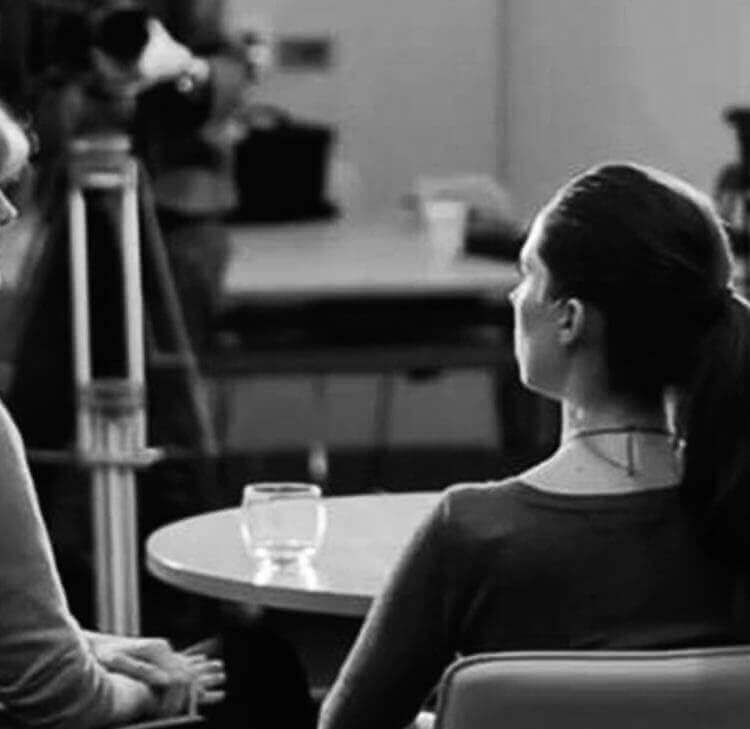
Living in the gaps: What disaster recovery teaches us about education leadership
Nick MacKenzie shares insights from his conversation with Professor Lucy Easthope, a leading authority on disaster recovery and Sunday Times bestselling author.
In the latest episode of our #EdInfluence podcast, Nick was joined by Lucy Easthope. Lucy is one of the UK's foremost authorities on disaster recovery. You might expect her to open with something darker. But that is exactly her point.
Disaster comes from the Greek for the aligning of bad stars. Lucy spends her career in close proximity to what that looks like. And Lucy shared it has taught her, above all else, to see when the stars align well.
An example Lucy uses is eloping at New York City Hall, asking two strangers to be witnesses and one of them turning out to be actor Alan Ruck from Ferris Bueller's Day Off.
The conversation was practical and personal - a challenge to anyone who thinks recovery has a neat finish line.
The language matters
Lucy is precise about the words we reach for after terrible events. Much of the language used in emergency response, she argues, is "very thoughtlessly hurtful." Recovery implies a finish line that doesn't exist.
She prefers survivance - a word that carries courage, defiance and a slight bit of rebellion. In her experience, “it's often school children and school leaders who set that tone after a disaster”, as happened in Southport. "You're living in the gaps, you're living in the spaces of uncertainty," she says.
Her academic work, published as The Recovery Myth, traces over a century of disaster sociology and the disaster recovery curve: the incubation phase, the incident itself, a honeymoon period of roughly eight to twelve weeks where communities pull together, and then the slump.
For education leaders, the graph has proved particularly powerful. It depersonalises the struggle. "There was always going to be a time after the pandemic," Lucy explains, but the pattern applies equally to schools dealing with stabbings, the aftermath of Grenfell, or any no-notice disaster.
Recognising where you sit on the curve - and understanding that the chronic slump from a world-changing event like the pandemic may last around 30 years - isn't intended to depress. It's intended to relieve the pressure on those who think they're failing when they are, in fact, exactly where the evidence says they should be.
Joy, play, small moments of delight - these aren't distractions from the work of reconstruction. They are the work.
Anhedonia - the quiet loss of joy
Lucy talks about anhedonia - the loss of joy. She made a colleague cry simply by asking when they last felt unfettered happiness. The answer was the end of 2019.
These are people with families. People with things in their lives worth being joyful about. But somewhere along the way, joy got quietly deferred - waiting, always, for a better time to feel better.
What Lucy has learned is that you cannot allow the big world factors to dictate how you set out your needs. Stop waiting.
Burnout, vocational awe and the discipline of rest
As the daughter and granddaughter of teachers, Lucy understands vocational awe - the pressure embedded in job adverts that ask educators not merely to deliver a curriculum but to change lives. Standard wellbeing advice isn't designed for roles where you can't bring your 'B game' to a year seven class or quietly quit while on a school residential.
The burnout she's seeing in education leaders is physical and visible. At events, phones sit on tables throughout; leaders leave mid-session because they've been called back. Left unaddressed, it surfaces as cortisol spikes, high blood pressure and stress-related illness.
Her practical advice is blunt. Take back control of your diary. Block out rest between meetings - Lucy jokes that hers is always a fictitious meeting with 'Alan'.
Find a burnout monitor: not a line manager, but a trusted friend who'll tell you honestly when you've become hard to live with.
“I am brutal about planning in my rest," she says. "Brutal about my burnout monitors, brutal with my fallow. But it's a discipline. ”
Hope and "hopium"
Lucy draws a sharp distinction between hope and what she calls "hopium". Hope is essential - "it's there in my surname," she says. But too much hope, unchecked by realism, strips people of their agency.
She points to Hurricane Katrina, where people died at home waiting to be evacuated. Emergency planners, she explains, stay optimistic in their personalities but pessimistic in their work. And they hold three activating words close: help isn't coming.
It is not pessimism. It is the kind of clear-eyed realism that preserves agency rather than eroding it.
When the response causes more harm than the crisis
Perhaps the most counterintuitive thing she said is that sometimes the response to a crisis causes more harm than the original event. Toxic positivity, phrases like "they didn't suffer" or "you're lucky to be alive" - these can become a secondary disaster. The best time to tackle what we get wrong, Lucy insists, is in peacetime.
“It's very difficult to say to people in the heat of the moment that actually that is the wrong thing to do.”
Rather than generating endless scenarios, Lucy advocates consequence-focused planning - preparing for a power cut, for example, which builds readiness for a wide range of disruptions.
The aim isn't to eliminate uncertainty but to reduce the startle factor. She's also candid about cultural barriers. Since around 2011, she's observed a shift away from being able to bring difficult questions to the executive table. "How safe is it to bring risk to your table?" she asks. "That's really interesting to me."
"I live with great delight"
The conversation closes with something quieter. Lucy lost her father in April 2023 and found herself tested against her own principles.
He had taught her the principles that she uses in her work. They only have today. They always said goodbye with love. She tries not to end a day on a row.
"I live with great delight." Her words, said simply.
One of the podcast's earlier guests, Fiona Forbes, shared that her mother had taught her to look for the gaps - because the gaps tell you more sometimes than the words do. Lucy's phrase went one step further. Not just looking for the gap. Choosing to live in it. To be present inside the uncertainty rather than rushing through to the other side.
When you only ever see sudden and interrupted ends - too soon, the day before it was all meant to be - the quiet ordinary moments look completely different.
What would change for you if you stopped waiting for the gap to close?
Listen to the full episode
This episode of #EdInfluence is available now. Subscribe wherever you get your podcasts, and share it with a colleague who leads through uncertainty.
#EdInfluence is Browne Jacobson's podcast series exploring the human side of leadership with some of education's most inspiring figures.
Contact
Nick MacKenzie
Partner
nick.mackenzie@brownejacobson.com
+44 (0)121 237 4564
You may be interested in

Self-care, curiosity and belonging from #EdInfluence podcast S5

#EdInfluence podcast (series 5): In conversation with inspiring leaders

What does it take to rebuild trust in an organisation where staff feel neglected and morale has collapsed?

Pause to go faster: What a vice-chancellor learned about leading when you can't fix it
Living in the gaps: What disaster recovery teaches us about education leadership

Andy Long on trust, social mobility and leading through uncertainty
When finance expertise meets education leadership: Lessons from Liberia to the classroom

From fear to fearless: Charlotte Blant on values-led leadership
From school election defeat to AI leadership: Insights from Paul Estes
#EdInfluence podcast (series 4): In conversation with inspiring leaders
#EdInfluence podcast (series 3) - in conversation with inspiring leaders
#EdInfluence podcast (series 2) - for education leaders